
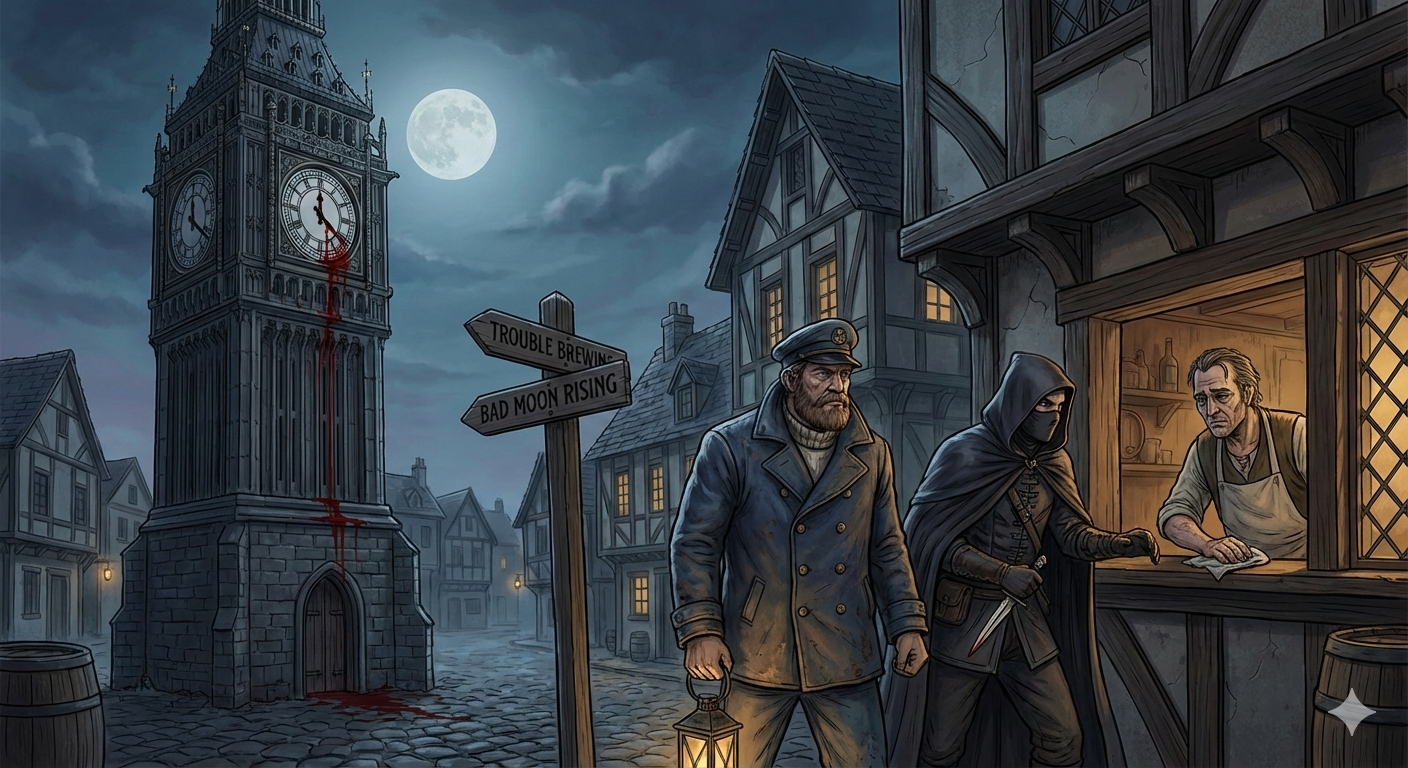
Death is Information: The Case for Bad Moon Rising
Once a group has mastered the deductive logic of Trouble Brewing, Bad Moon Rising serves as the perfect, chaotic graduation. It shifts the focus from pure information gathering to action, risk, and deduction through death patterns.
If Trouble Brewing is about finding the lie, Bad Moon Rising is about surviving the truth. It teaches players that death is not just an end state, but a primary source of information.
Death is Information
The biggest lesson Bad Moon Rising teaches coming from Trouble Brewing is that night deaths are a puzzle, not just a scoreboard.
- Multiple deaths can happen in a single night.
- Zero deaths might mean protection, or just a quiet Demon.
- Good players can be responsible for killing other players.
- The timing of a death reveals as much as the role alignment.
Players learn to stop asking “Who died?” and start asking “Why did they die right now?”
Active Play and Gambling
While Trouble Brewing rewards careful observation, Bad Moon Rising rewards action. Characters like the Gambler, Gossip, and Exorcist force players to make tangible moves that alter the game state.
Risk Management
Players are introduced to the concept that information has a cost. You might learn a role, but you might die for it. This introduces a layer of calculated risk absent in the beginner script.
Mechanical Bluffs
Evil must bluff not just information, but mechanical interactions. A Demon claiming to be a Sailor must be prepared to survive an execution to prove it, teaching Evil players to manipulate game mechanics rather than just social reads.
Protection and Resilience
In Trouble Brewing, staying alive is mostly about keeping your head down. In Bad Moon Rising, staying alive is a mechanic.
The Power of Survival
Roles like the Sailor, Tea Lady, and Fool teach the town that a player who doesn’t die is often more informative than one who does.
Testing Claims
The script introduces the strategy of executing players specifically to test their abilities. Town learns to use the block as a tool for confirmation rather than just removal.
The Demon’s Playground
The Demons in Bad Moon Rising—the Zombuul, Pukka, Shabaloth, and Po—operate on different timelines than the Imp.
- Players learn to track “delayed” deaths (Pukka).
- Players learn that dead players can still be threats (Zombuul).
- Players learn to fear massive bursts of mortality (Po).
This forces the Good team to adapt their pacing and execution strategy based on which Demon they suspect is in play.
A Step Up for Storytellers
For the Storyteller, moving to Bad Moon Rising teaches complex death arbitration.
- Managing multiple kill causes.
- Deciding who dies when abilities clash.
- Balancing the game through the timing of deaths.
It is a challenging script to run, but mastering it gives a Storyteller complete confidence in mechanics and interactions.
Understanding the Meta
Because Bad Moon Rising is so mechanically dense, the “meta” evolves rapidly. Strategies that work in game one (like the Gossip killing every night) may be countered by game three.
This dynamic nature teaches groups that no strategy is permanent and that adaptation is the key to victory.
Tracking the Chaos
With so many causes of death and complex interactions, memory alone is often insufficient to analyze how a game was won or lost.
That’s where botc-tracker.com comes in.
Logging Bad Moon Rising games helps groups disentangle the web of night actions, revealing which risks paid off and which bluffs went undetected amidst the bloodshed.
If Trouble Brewing is a logic puzzle, Bad Moon Rising is a thriller, and it teaches you how to keep your cool when everything is exploding.