
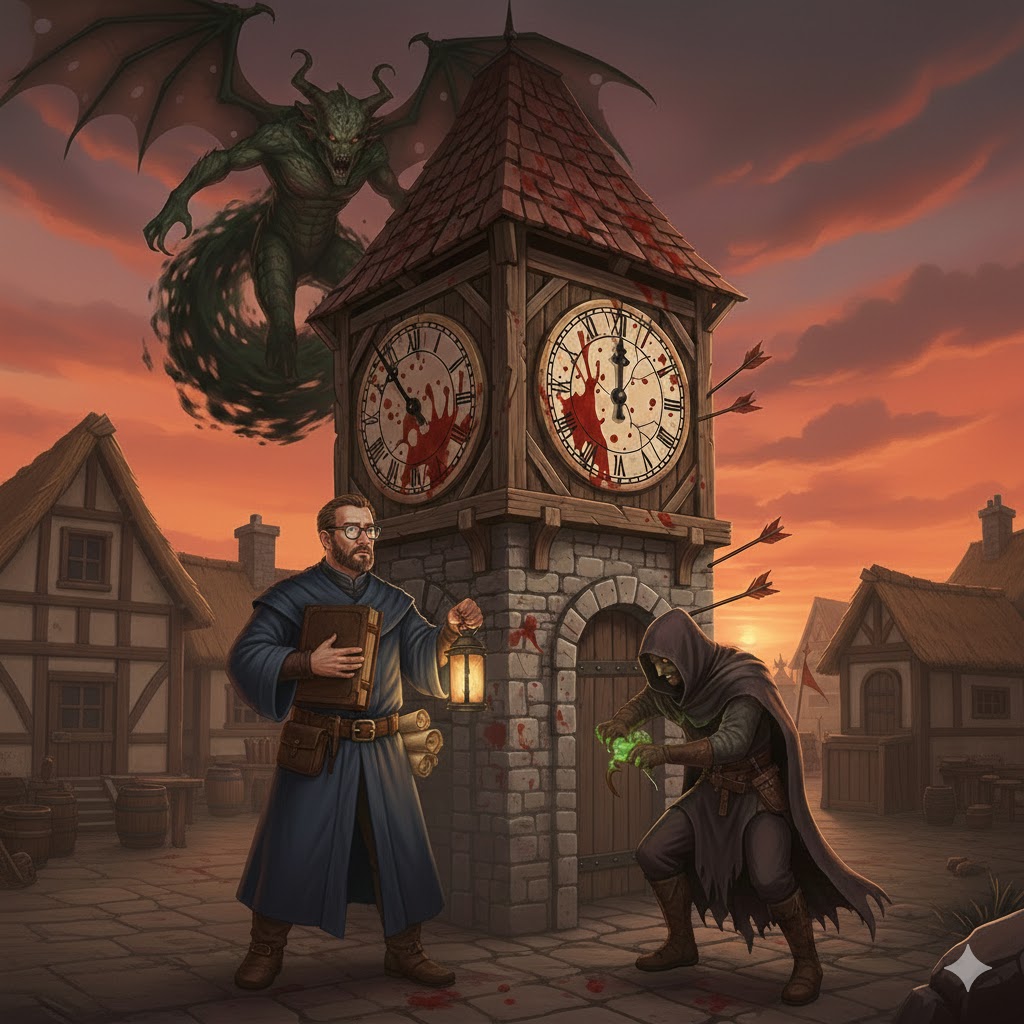
An Introduction to Blood on the Clocktower
Blood on the Clocktower is a social deduction game about trust, lies, logic, and storytelling. If you like games such as Werewolf or Mafia, this lives in the same family, but with far more depth, player agency, and room for clever plays on both sides.
It’s a game where everyone has something to do, right up until the final moment… even after death.
The Core Idea
At its heart, Blood on the Clocktower is a battle between Good and Evil.
- Good wins if they successfully execute the Demon.
- Evil wins if the Demon survives until only two players are left alive.
One player takes on the role of the Storyteller, who moderates the game, provides information, and makes judgment calls. Everyone else is a player, sitting in a circle, the “clocktower”.
Each player receives a unique character, each with a special ability. Some abilities give information, some manipulate the game state, and others exist to mislead or cause chaos.
The Teams
There are four character types:
Townsfolk (Good)
These are the backbone of the Good team. Townsfolk usually receive information, clues about other players, roles, or the state of the game. Their challenge is figuring out what information is reliable and what’s been tampered with.
Outsiders (Good, but…)
Outsiders are still on the Good team, but their abilities are actively harmful to Good. Knowing (or hiding) that you’re an Outsider can be crucial.
Minions (Evil)
Minions support the Demon by spreading misinformation, disrupting abilities, or protecting the Demon from execution. They usually know who the Demon is.
Demon (Evil)
The Demon is the primary threat. Each night, the Demon typically kills a player and works with the Minions to stay hidden. If the Demon dies, Evil loses, immediately.
How the Game Flows
The game alternates between night and day phases.
Night
- Players close their eyes.
- The Storyteller wakes specific characters one at a time.
- Abilities are used: information is given, players may die, characters may change, or game rules may be altered.
Importantly, the Storyteller may lie to players who are Drunk or Poisoned, meaning not all information is trustworthy.
Day
- Everyone talks openly.
- Players share (or lie about) what they know.
- Private conversations are allowed.
- One player may be executed if nominated and approved by a majority vote.
Execution is the only way the Demon can be killed.
Death Is Not the End
One of Blood on the Clocktower’s defining features is that dead players still participate:
- Dead players can talk freely.
- They keep their character ability unless it specifies otherwise.
- They have one final vote for the rest of the game.
This keeps everyone engaged and prevents early eliminations from feeling pointless.
Voting & Execution
- Any living player may nominate another living player.
- Everyone votes simultaneously.
- A nomination passes if it receives more votes than any previous nomination that day.
- Dead players may vote by spending their single vote token.
At most one execution happens per day.
Changing Characters & Hidden Information
Not every character stays the same for the entire game.
Some abilities can:
- Make players Drunk or Poisoned, causing false information
- Change characters mid-game
- Swap roles between players
- Cause Evil players to appear Good, or vice versa
This means the character you started as may not be the character you ended as, and understanding these changes is often key to solving the puzzle.
The Storyteller’s Role
The Storyteller is not trying to win.
Their job is to:
- Run abilities correctly
- Maintain game balance
- Make fair judgment calls
- Ensure the game is tense, dramatic, and fun
A good Storyteller will sometimes bend probability, but never the rules, to give both teams a fighting chance.
Editions & Scripts
The game ships with three core editions:
- Trouble Brewing (recommended for beginners)
- Bad Moon Rising
- Sects & Violets
Each edition contains a different mix of characters and mechanics. Custom “scripts” allow near-infinite replayability once you’re comfortable with the rules.
Why People Love It
- No one is sidelined early
- Every game tells a story
- Information is layered, imperfect, and fascinating
- Bluffing is just as important as logic
- Even losing can feel satisfying
Every session produces memorable moments, heroic sacrifices, bold lies, and last-second revelations.
Tracking Your Games
Once you start playing regularly, patterns emerge: favorite characters, win rates, balance shifts, and unforgettable twists.
That’s where botc-tracker.com comes in.
The app lets you log your games, tracking wins and losses, team alignment, starting and ending characters, and then explore trends like most-played roles or win percentages over time. It’s designed to be lightweight, optional, and useful for groups who want to reflect on their games without getting in the way of playing them.
Whether you’re new to the clocktower or already deep into custom scripts and wild world-ending plays, welcome, and trust no one.