
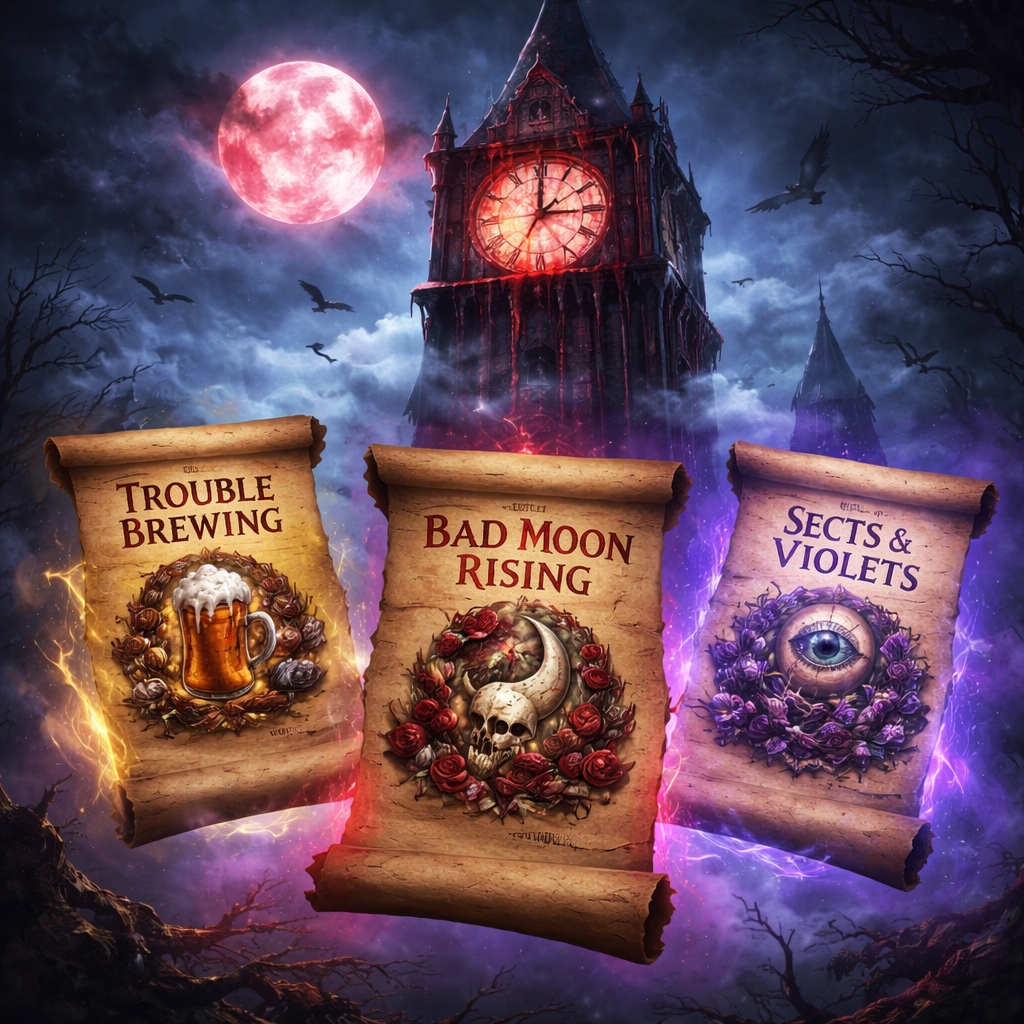
Why Base-3 Scripts Prepare You for Custom Chaos
The three base scripts of Blood on the Clocktower are often seen as a beginner’s trilogy: Trouble Brewing, Bad Moon Rising, and Sects & Violets. But their true purpose isn’t just onboarding.
Together, they form a curriculum that prepares players and Storytellers for the wild, unstructured chaos of custom scripts.
Three Scripts, Three Mental Models
Each base script teaches a fundamentally different way of thinking about the game. Custom scripts pull from all three simultaneously.
- Trouble Brewing teaches trust and misinformation.
- Bad Moon Rising teaches timing, death, and risk management.
- Sects & Violets teaches uncertainty, identity fluidity, and social performance.
By the time players reach custom scripts, they are expected to juggle all of these skills at once.
Trouble Brewing: Foundations of Trust
Trouble Brewing teaches the fundamentals of social deduction. Information is scarce, alignment is mostly fixed, and lies are deliberate.
Stable Identities
Characters rarely change, alignments rarely flip, and the game state is mostly static. This allows players to build logical worlds and practice reading social behaviour.
Controlled Misinformation
Poisoning and drunkenness exist, but they are limited and learnable. Players learn to distrust information without abandoning logic entirely.
Bad Moon Rising: Embracing Death and Chaos
Bad Moon Rising teaches that death is information, and that survival is not always optimal.
Living Information
Many characters gain power by dying. Execution timing becomes a strategic resource rather than a punishment.
Unreliable Timelines
With multiple night deaths, resurrection, and delayed effects, players learn that cause and effect in Clocktower is often non-linear.
Sects & Violets: Psychological Uncertainty
Sects & Violets removes the last remaining certainties.
Fluid Roles and Alignments
Characters can change, teams can swap, and information can be intentionally inverted. Players learn to treat their own identity as provisional.
Performance Over Honesty
Madness mechanics teach that social behaviour is no longer a reliable signal. Players must separate acting from alignment.
Why Custom Scripts Feel So Wild
Custom scripts mix these philosophies freely. A single game might include:
- Stable TB-style roles.
- High-death BMR mechanics.
- S&V-style madness and role-swapping.
Without the mental frameworks from the base scripts, custom games can feel incomprehensible rather than complex.
Training for Storytellers
The base scripts also train Storytellers in escalating responsibility.
- Trouble Brewing teaches basic rules arbitration.
- Bad Moon Rising teaches timing and layered effects.
- Sects & Violets teaches active narrative control.
Custom scripts demand all three at once, turning the Storyteller into a systems designer as much as a referee.
From Curriculum to Sandbox
The base scripts are not just starter content; they are a structured education in Clocktower theory. Custom scripts are the sandbox where all those lessons collide.
If Trouble Brewing teaches you to think, Bad Moon Rising teaches you to adapt, and Sects & Violets teaches you to doubt.
Custom scripts expect you to do all three at once.
Tracking the Chaos
When custom scripts blend misinformation, death mechanics, madness, and role changes, tracking the true game state becomes nearly impossible by memory alone.
That’s where botc-tracker.com becomes essential.
Logging custom games allows players and Storytellers to reconstruct the hidden logic of the game, revealing how chaos often followed a perfectly consistent internal system.
The base scripts teach you the rules. Custom scripts test whether you actually learned them.