
How to Review a Blood on the Clocktower Game After It Ends
Blood on the Clocktower does not really end when the final execution is made. For many groups, the best part comes afterwards, when everyone gathers around the Storyteller, asks what happened, and slowly realises how many things they misunderstood.
That post-game conversation is one of the reasons Clocktower is so memorable. Players compare worlds, reveal bluffs, laugh at mistaken theories, and finally learn which pieces of information were true, poisoned, drunk, or cleverly manipulated.
Why Post-Game Review Matters
A game of Blood on the Clocktower contains a huge amount of hidden information. During play, each person only sees a small part of the whole picture.
- One player may be focused on their own ability.
- Another may be tracking social reads.
- Another may be watching nominations and voting patterns.
- The evil team may be trying to keep several bluffs alive at once.
After the game, everyone finally gets access to the full story. This is the moment when players can understand not only what happened, but why it happened.
Start With the Story, Not the Mistakes
It is tempting to begin a review by pointing out the moment someone “should have known” something. That can be useful, but it is rarely the best place to start.
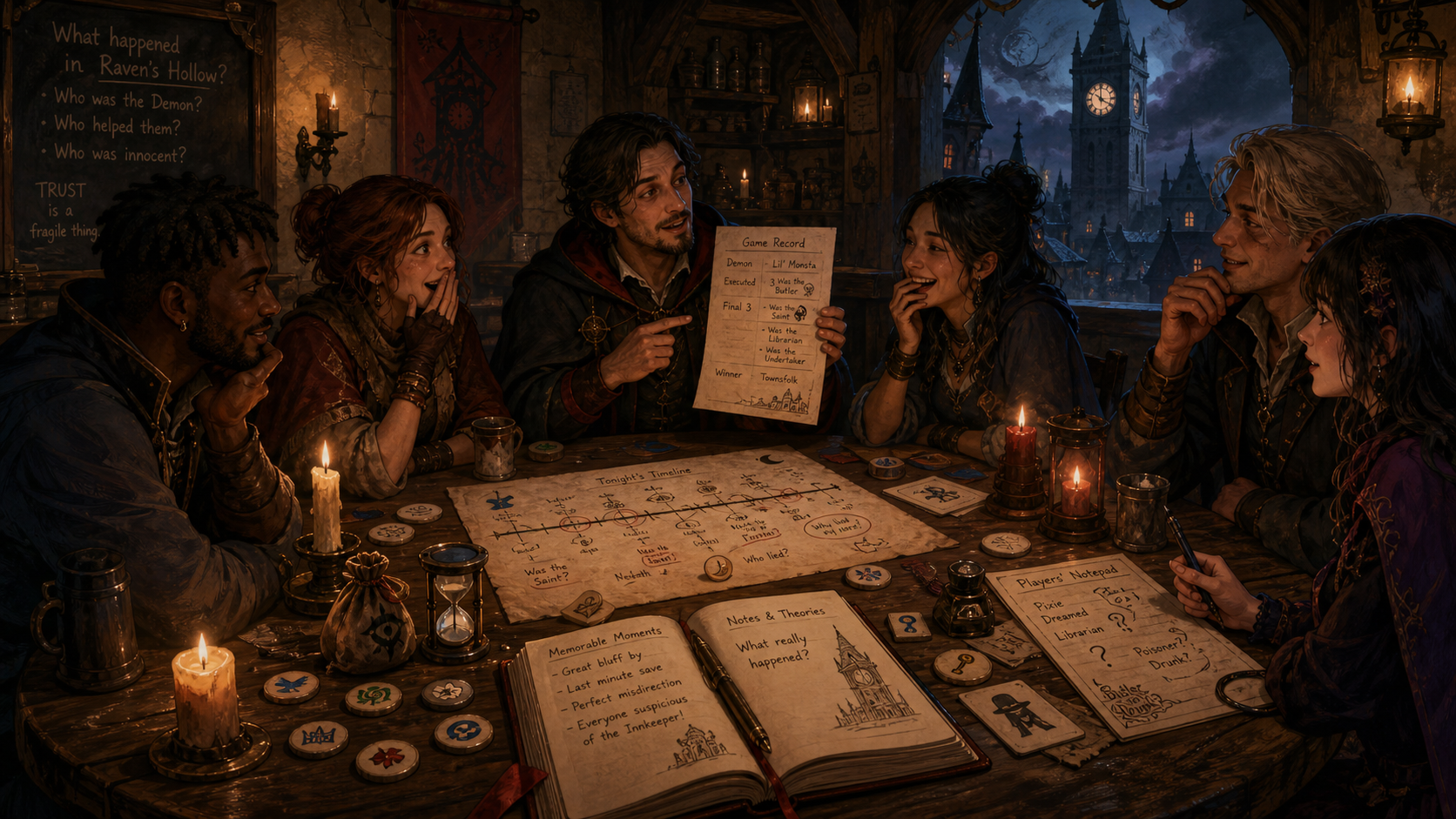
Rebuild the Timeline
A better approach is to reconstruct the story of the game. Who received what information? Which claims were made early? When did trust form? Which worlds were considered? What changed after each death or execution?
Keep the Conversation Constructive
This makes the review feel like discovery rather than criticism. Players are more likely to learn from the game when they understand the full chain of events.
Separate Bad Decisions From Unlucky Information
Clocktower often creates situations where a sensible decision leads to a terrible result.
- A player may trust information that was poisoned.
- A town may execute someone because every available clue points the wrong way.
- An evil player may win because their bluff fitted the script perfectly.
This distinction matters. Not every loss means someone made a mistake. Sometimes the game worked exactly as intended: players had incomplete information and had to act anyway.
Look for Group Patterns
Individual games are interesting, but repeated patterns are even more valuable. Over time, a group may notice that it tends to trust certain types of information too much, execute quiet players too quickly, ignore Outsider claims, or underestimate obvious Demon candidates.
These patterns are not necessarily bad. They are part of a group’s meta. But once players notice them, they can begin to adapt.
What to Record After a Game
A useful record does not need to be complicated. The most important details are usually the script, player count, characters, final alignments, Storyteller, and winning team.
If you want a richer record, add notes about key moments:
- A bluff that changed the game.
- A nomination that shifted the town’s focus.
- A poisoned or drunk piece of information.
- A character change or alignment change.
- A final three decision.
Use Statistics Carefully
Statistics can support a review, but they should not replace discussion. A player’s win rate does not explain whether they solved the game. A character’s win rate does not prove whether it is strong. A script result does not always reveal whether the setup was balanced.
The best use of statistics is to create better questions.
A Better Memory of the Game
Blood on the Clocktower is built from hidden information, social pressure, risk, and surprise. That makes it difficult to remember clearly, but also worth preserving.
That’s where botc-tracker.com helps.
Recording games makes it easier to understand the stories your group creates, compare sessions over time, and remember the details that would otherwise fade before the next game night.