
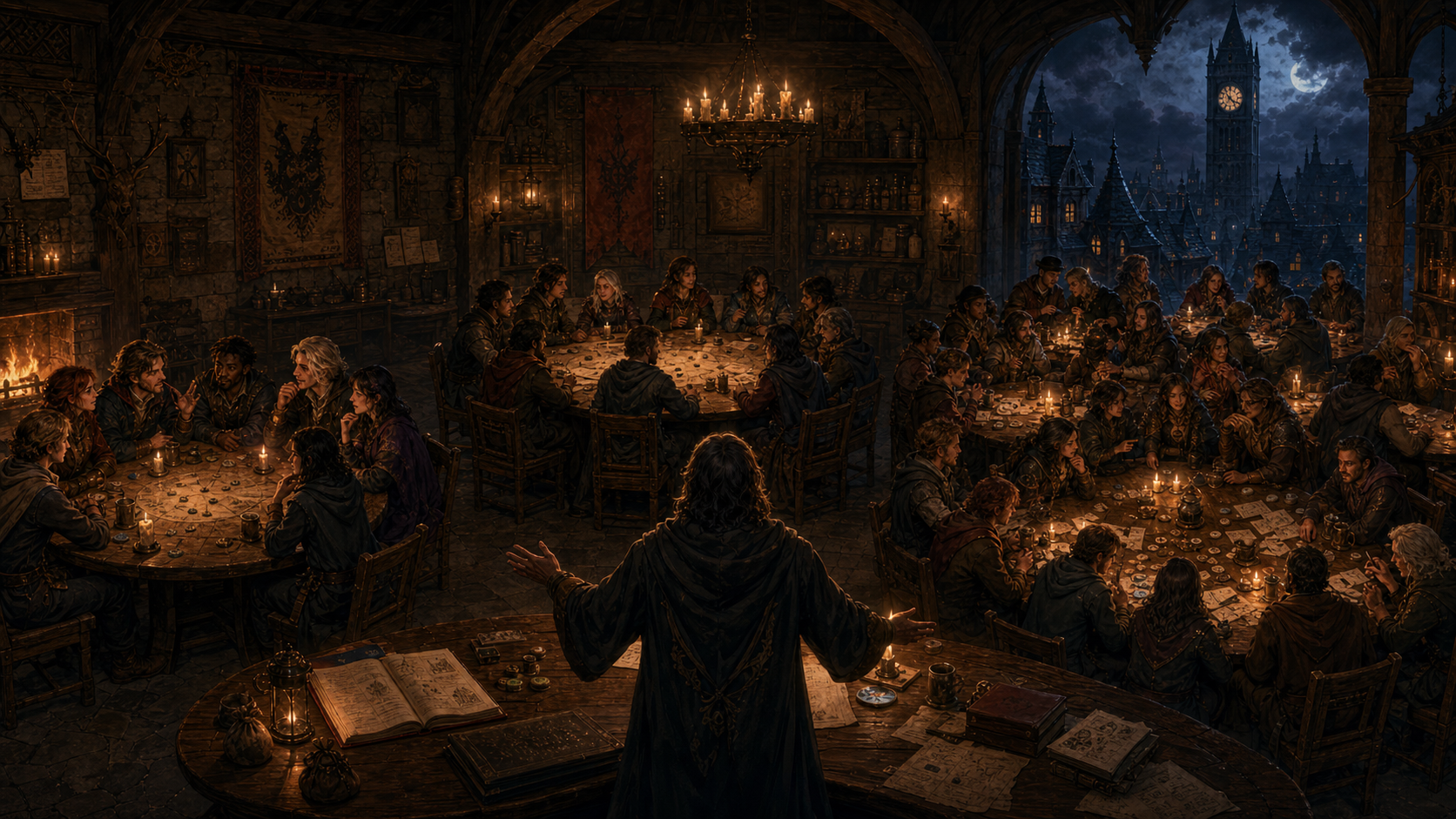
Why Player Count Changes Everything in Blood on the Clocktower
A game of Blood on the Clocktower with seven players can feel completely different from a game with fifteen. The rules may be the same, the script may be the same, and the Storyteller may be the same, but the shape of the game changes dramatically as the circle grows.
Player count affects almost every part of Clocktower: how much information enters the game, how much space Evil has to hide, how nominations feel, how private conversations work, and how quickly the town can narrow down possible worlds.
Small Games Are Personal
In smaller games, every player matters immediately. There are fewer places to hide, fewer claims to compare, and fewer executions available before the game reaches its final stage.
Sharper Accusations
A single accusation carries more weight because there are not many alternative candidates. Every death removes a large part of the town’s information network.
Less Room for Evil
Evil players have fewer places to disappear. Survival often depends on confidence, timing, and choosing a bluff that can withstand immediate attention.
Medium Games Create the Classic Rhythm
Many groups find that medium-sized games produce the most familiar Clocktower rhythm. There are enough players for multiple worlds to exist, but not so many that the town becomes impossible to follow.
In this range, information can cross-check in interesting ways. Private conversations matter, but public discussion still has structure. Evil has room to hide, but not unlimited space.
Large Games Are About Information Management
Large games are a different challenge. More players means more claims, more private conversations, more possible bluffs, and more ways for information to be lost or misunderstood.
Good Has More Information
More players often means more useful abilities and more perspectives, but that does not automatically make the game easier.
Evil Benefits From Noise
If the town cannot organise its information, a Demon can survive simply because there are too many possible worlds to resolve.
Executions Feel Different at Every Size
The value of an execution changes with player count. In a small game, each execution is precious. Removing one good player can bring the town dangerously close to losing.
In a larger game, the town may have more room to test claims, but each execution can also create more social chaos.
- Small groups may become cautious because every mistake feels expensive.
- Medium groups often balance risk and information well.
- Large groups may execute more freely because the cost feels spread out.
Some Characters Scale Differently
Not every character feels the same at every player count. Some abilities become more powerful when there are more players to choose from. Others become easier to test in smaller games.
This is one reason character statistics need context. A character’s overall win rate may hide major differences between small, medium, and large games.
Why Storytellers Should Care
Player count affects pacing, balance, and pressure. A script that feels clean at nine players may feel chaotic at fourteen. A setup that gives Evil enough cover in a large game may be too exposed in a small one.
Good Storytellers learn to read the size of the circle as part of the game state.
How Tracking Helps
Recording player count alongside each game can reveal patterns that memory alone may miss.
- Your group may discover that Good wins more often in medium games.
- Evil may perform better when the circle is large.
- Certain scripts may feel more balanced at particular sizes.
The Circle Changes the Story
Blood on the Clocktower is not just a set of characters. It is a social structure, and that structure changes depending on how many people are in the circle.
That’s where botc-tracker.com becomes useful.
By recording player count, scripts, characters, and results, groups can better understand why their games feel the way they do, and how to make the next session even better.