
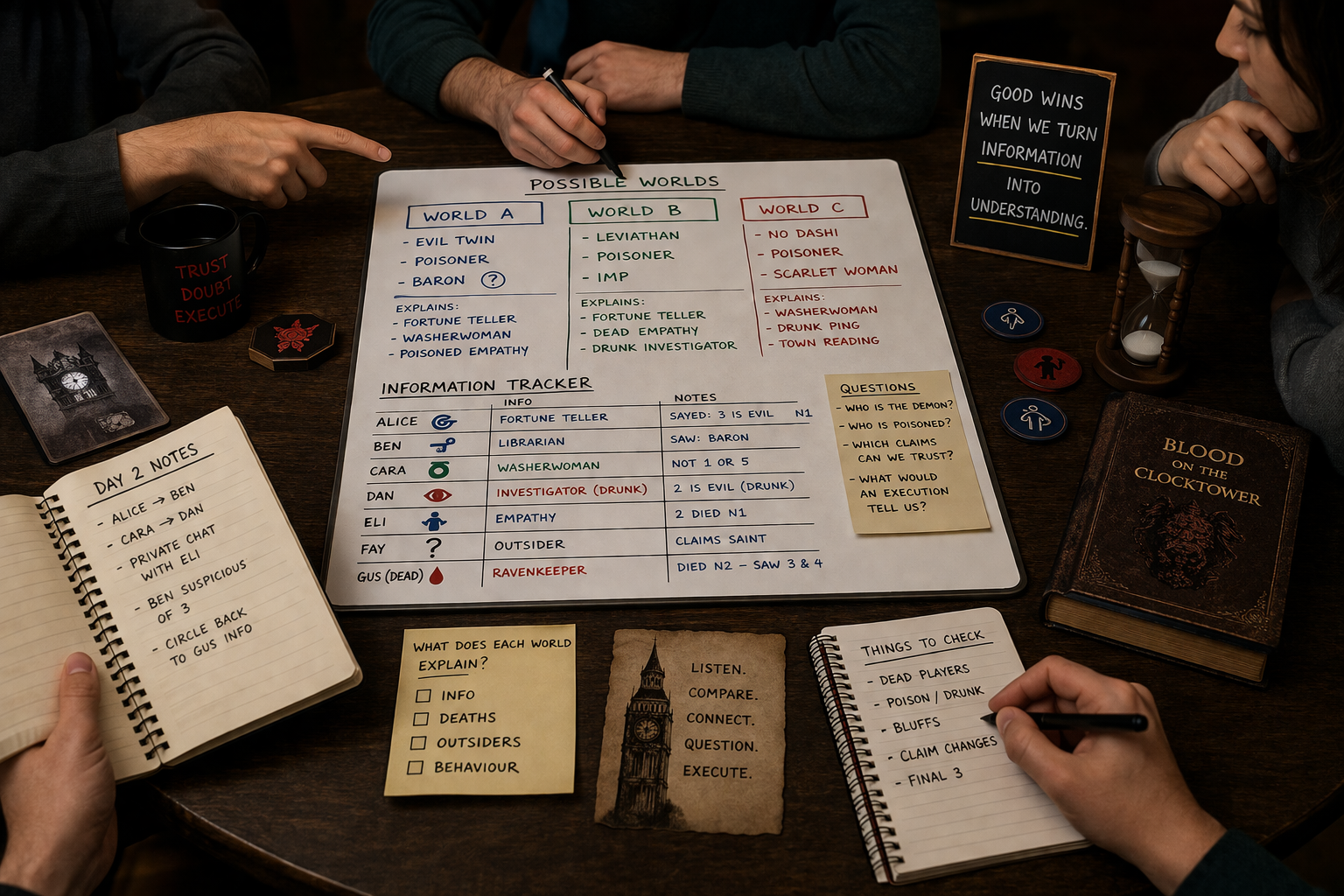
How Good Towns Organise Claims
In Blood on the Clocktower, information is rarely just true or false. It arrives through characters, timing, social pressure, poisoning, drunkenness, bluffs, and the very human problem of remembering what everyone said two days ago.
That is why the strongest towns are not always the ones with the most information. They are the ones that organise information well.
The Difference Between Information and Understanding
A town can have plenty of information and still lose badly. Several players may have useful claims, but if those claims are scattered, misunderstood, or never compared, they do not become a coherent world.
Understanding begins when players connect claims together. A Washerwoman claim may matter more when compared with a Fortune Teller result. A death pattern may become clearer when matched against protection claims. An Outsider count may suddenly change how the entire script is read.
Information Is Local
Most players begin the game with a narrow view. They know their own character, their own information, and the private conversations they have had.
Understanding Is Shared
The town improves when those local pieces become part of a public or semi-public structure. That does not mean everyone needs to hard-claim immediately, but it does mean useful information has to travel eventually.
Why Claims Get Lost
Even experienced groups lose track of claims. Clocktower creates a lot of moving parts, and not every detail feels important at the moment it is said.
- A player whispers a key detail to only one person.
- A claim is made publicly but buried under a louder accusation.
- Someone changes their claim and the first version is forgotten.
- A dead player’s information is ignored because they are no longer active.
- Several worlds sound similar enough that people mix them together.
None of this means the town is playing badly. It means the game is doing what it is designed to do: forcing players to manage uncertainty under pressure.
Good Information Needs a Shape
Strong towns often give their information a shape. They do not just collect claims; they organise them into possible worlds.
A world is a version of the game that could be true. It explains who the Demon might be, which information can be trusted, which players are likely evil, and which claims are probably distorted by poisoning, drunkenness, or bluffing.
Do Not Build Only One World
The danger of a single world is that it can feel comforting even when it is wrong. Once a town decides too early that one explanation is correct, every new piece of information may be forced to fit it.
Keep Rival Worlds Alive
Better towns often keep two or three serious worlds in discussion. They ask what each world explains, what each world struggles with, and which execution would give the most useful result.
The Role of Public Discussion
Private conversations are one of Clocktower’s great strengths, but public discussion is where the town’s shared memory forms.
A private whisper can protect a powerful role or test a social read. But if too much important information stays private forever, the town may enter the final day with only fragments of the truth.
- Private chats are good for building trust.
- Public discussion is good for comparing worlds.
- Final-day decisions need enough shared context to be meaningful.
The balance between secrecy and openness is one of the most important skills in the game.
When to Share Information
There is no perfect rule for when to reveal information. A first-night character may want to speak early. A powerful ongoing role may need protection. A player with suspicious information may wait to see whether Evil exposes itself.
The question is not simply “Should I reveal?” but “What does the town gain or lose if I reveal now?”
Early Sharing Builds Structure
Revealing some information early can give the town a framework. It allows other players to compare claims, test assumptions, and notice contradictions.
Late Sharing Preserves Leverage
Holding information back can protect a role or catch a bluff. But waiting too long can also mean the town never has time to use the information properly.
Dead Players Still Matter
One of the distinctive features of Blood on the Clocktower is that dead players continue to talk. This changes the value of information dramatically.
A dead player may no longer be alive, but their claim, social reads, and final vote can still shape the game. In some scripts, death may even make a player’s information more important rather than less.
Ignoring dead players is often a mistake. Their perspective can be clearer because they are no longer trying to survive. They may also have had private conversations that living players never heard.
Information Can Be Too Neat
Sometimes the town loses because a world looks too clean. Every claim appears to line up, every accusation feels logical, and the execution seems obvious.
That neatness can be real. It can also be the result of Evil successfully shaping the information structure.
- A bluff may support a good player’s false assumption.
- A poisoned result may make an innocent player look confirmed evil.
- A Demon may survive because the town’s world leaves no room for doubt.
Good players should be willing to ask why a world feels clean. Did the town build it, or was it handed to them?
Reviewing Information After the Game
The best time to understand the town’s information structure is often after the reveal. At that point, players can see which claims were true, which were lies, and which were distorted by the game’s mechanics.
Post-game review can show where information broke down:
- Was a true claim ignored?
- Did Evil create a false centre of trust?
- Did the town reveal too much too early?
- Did important information stay private until it was too late?
Tracking the Town’s Memory
Because Clocktower games are so conversational, it is easy to remember the final result but forget how the town got there.
That’s where botc-tracker.com can help.
Recording the script, characters, results, and notes from a game gives your group a better memory of how information moved around the table. Over time, you may notice whether your group tends to trust certain claims too much, reveal too late, or let important information vanish before the final day.
In Clocktower, information wins games only when players can turn it into understanding.