
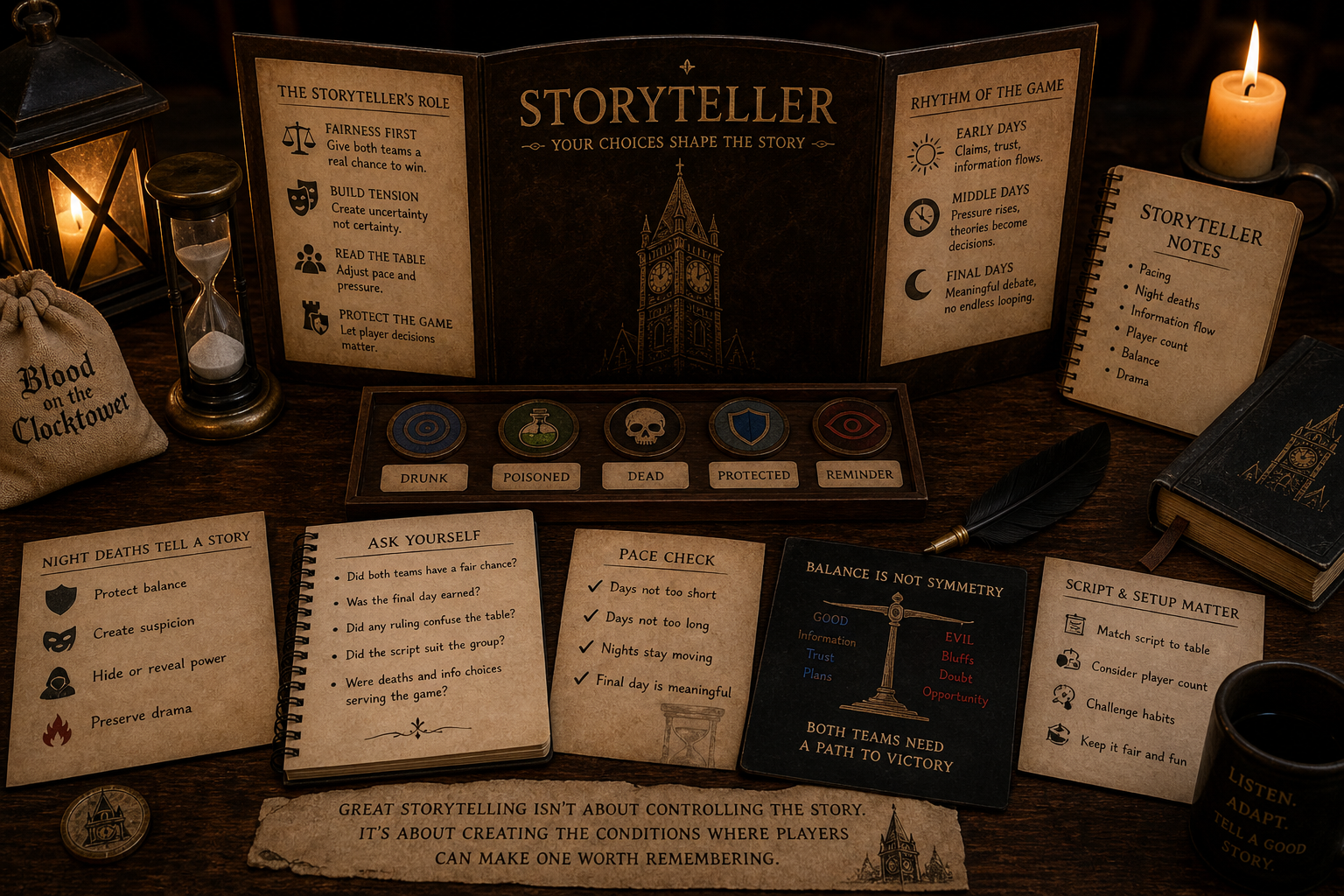
The Art of Storytelling in Blood on the Clocktower
Storytelling in Blood on the Clocktower is often described as running the rules, waking characters, and giving correct information. That is true, but it is only the surface.
A good Storyteller is also managing rhythm, pressure, uncertainty, fairness, and drama. They are not trying to make one team win, but they are constantly shaping the conditions that allow a game to become tense, readable, and memorable.
The Storyteller Is Not a Referee Only
In many games, a referee exists mainly to enforce rules. In Clocktower, the Storyteller does enforce rules, but they also make choices that influence the texture of the game.
Which character receives drunk information? Who dies at night? Which reminder token matters right now? How much time does the town need before nominations? These decisions do not remove player agency, but they do affect how the story unfolds.
Fairness Comes First
The Storyteller should give both teams a real chance to win. Their choices should create tension, not secretly decide the outcome.
Drama Comes From Uncertainty
The best games often live in the space where both teams can see a path to victory, but neither side feels completely safe.
Pacing Is a Storyteller Skill
Pacing is one of the most important and least visible parts of Storytelling. Players usually notice it only when it goes wrong.
If days are too short, players feel rushed and important conversations never happen. If days are too long, the energy drops and the game can become muddy. If nights drag, dead time starts to weaken the table’s focus.
- Early days often need enough time for claims and trust to form.
- Middle days need pressure so theories become decisions.
- Final days need space for meaningful debate without endless looping.
A good Storyteller reads the room and adjusts without making the game feel forced.
Night Deaths Tell a Story
In scripts with flexible night deaths, the Storyteller’s choices can shape what the town believes is happening.
A death can protect balance, reward clever play, create suspicion, hide a powerful role, or preserve a dramatic final day. It can also accidentally confirm too much or remove the wrong source of tension.
Do Not Kill Only for Surprise
A surprising death can be fun, but surprise alone is not always useful. The question is what the death does to the game.
Think About Information Flow
Killing a player may silence an ability, but it may also make their claim more trusted. Leaving a player alive may keep suspicion on them, or it may allow them to solve the game.
Balance Is Not Symmetry
A balanced Clocktower game does not mean both teams feel equal at every moment. Sometimes Good has a burst of strong information. Sometimes Evil gains control of the conversation. Sometimes a single execution changes everything.
Balance is more about whether both teams have meaningful routes to victory. A game can feel chaotic, tense, or even lopsided for a while and still end in a fair final decision.
The Storyteller Should Protect the Game, Not the Players
It can be tempting to protect a player from a bad outcome, especially if they are new, unlucky, or about to make a mistake. But Clocktower works because player decisions matter.
The Storyteller’s job is not to rescue players from every consequence. It is to make sure those consequences happen inside a fair and understandable game.
- Let good deductions matter.
- Let strong bluffs matter.
- Let risky nominations matter.
- Let mistakes matter when they are part of the game.
New Players Need Clarity
When a table includes newer players, the Storyteller has an extra responsibility to keep the game readable.
This does not mean making the game easy. It means avoiding unnecessary opacity. New players should be confused by the social puzzle, not by preventable rules uncertainty.
Explain Procedures Clearly
Nominations, voting, death, ghost votes, night order, and character reminders should feel smooth and predictable.
Choose Scripts Thoughtfully
A script that is exciting for veterans may be exhausting for beginners. The Storyteller should match the script to the table, not just to their own taste.
Experienced Groups Need Fresh Pressure
Veteran groups can develop habits. They may trust certain players too much, solve familiar scripts quickly, or fall into predictable execution patterns.
A Storyteller can respond by choosing scripts, setups, and pacing that challenge those habits without feeling unfair.
- A cautious group may need scripts that reward action.
- An aggressive group may need scripts where death has consequences.
- A logic-heavy group may enjoy uncertainty and social performance.
- A socially driven group may benefit from clearer mechanical anchors.
Reviewing Storyteller Decisions
The best Storytellers reflect after games. They ask not only whether the game was legal, but whether it was satisfying.
Useful questions include:
- Did both teams have a fair chance?
- Was the final day earned?
- Did any ruling or choice confuse the table unnecessarily?
- Did the script suit the group and player count?
- Were deaths and information choices serving the game?
This kind of review helps Storytellers improve without turning every decision into a mistake to be defended.
Tracking Storyteller Patterns
Individual games can be hard to evaluate in isolation. A dramatic Evil win might be excellent Storytelling, or it might reveal that a script is too punishing for your group. A run of Good wins might show strong town play, or it might suggest that Evil is not getting enough cover.
That’s where botc-tracker.com becomes useful.
By recording Storytellers, scripts, player counts, characters, and results, groups can review their games across time rather than relying on memory alone. This can help Storytellers notice patterns, choose future scripts, and better understand how their decisions shape the experience at the table.
Great Storytelling is not about controlling the story. It is about creating the conditions where players can make one worth remembering.